Why DFW Homebuyers Have More Negotiating Power With Builders Right Now
The DFW new construction market is creating opportunities for buyers, and some of the biggest homebuilders are showing signs of growing pressure. While I don't sell many homes from Lennar, D.R. Horton, or other publicly traded production builders, I pay close attention to what these companies reveal about their sales, inventory, and profit margins. When one of the largest homebuilders in the country starts making changes to meet its sales targets, it can signal what's happening across the broader housing market.
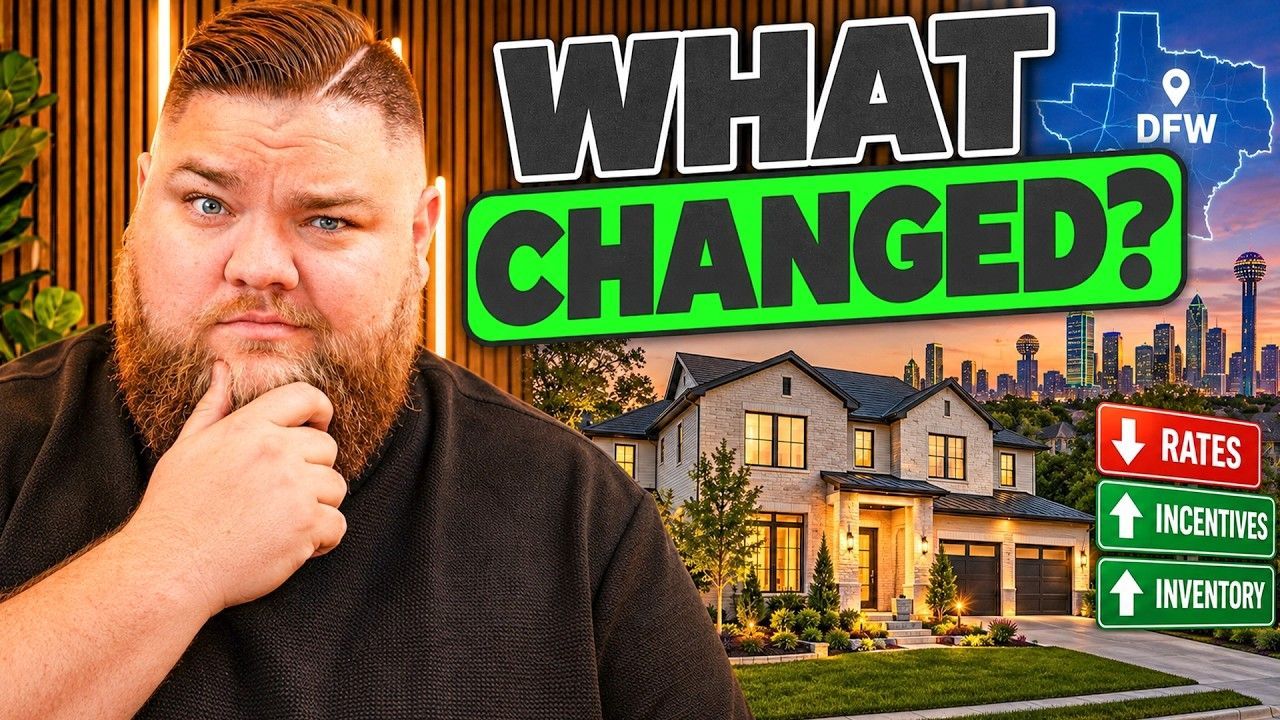
Right now, DFW homebuilders are facing pressure from multiple directions, including shareholder expectations, quarter-end sales goals, and growing inventory. To keep homes moving, builders are offering incentives, reducing profit margins, and becoming more motivated to close deals. For buyers considering a new construction home in Dallas-Fort Worth, understanding these market conditions could create an opportunity to negotiate better pricing, closing cost assistance, and mortgage rate buydowns.
This isn't about recommending one builder over another. It's about understanding what's happening behind the scenes and knowing how to use that information to your advantage. Let's look at why builders are feeling the pressure, what their latest moves could mean for DFW homebuyers, and how to negotiate a new construction deal that makes financial sense.
Table of Contents
Why Lennar's Sales Pressure Reveals Market-Wide Trends
Lennar's CEO recently said they needed to close 22,000 to 23,000 homes by the end of this year. And if they're going to do it, they're giving up margin. So how much money are they making on every house? They're giving up more margin in order to be able to do that.
If one of the largest builders in America is feeling this pressure, you can probably bet on the fact that most other builders are feeling the pressure too. Probably not at the largest scale that Lennar is feeling it, but they're feeling it.
Big public builders answer to shareholders and stockholders and to Wall Street, and they have to report every 90 days. They have to talk about their earnings, their revenue, how many homes they sold, how many starts. So this is public information we can use to see what we can see. Canary in the coal mine.
Lennar's Q3 from this year was 20,840 closings versus trying to get between 20,000 and 21,000. They were down 9% on their orders and their net earnings were $284 million versus $591 million a year ago. And they were saying their average incentive was 12% of the purchase price. They are compromising margin in order to maintain volume. It is deliberate.
The Lennar and Millrose Connection: What It Means for Buyers
Here's where it gets interesting. In 2025, Lennar spun off a secondary company called Millrose. Millrose holds the dirt for Lennar, so they do all the development, and then Lennar pays Millrose to buy the dirt back when they're ready to start developing.
Well, then in August of this year, Millrose changed their agreement so that Lennar was buying dirt, but now Millrose can buy houses back from Lennar. This is disclosed in a filing in September. And then there was this report that comes out from HunterBrooke, a company that's actually betting against them. They estimated that somewhere over $200 million worth of Lennar's completed homes was sold back to Millrose. Earlier this month in October, they raised that to $290 million worth of real estate sold back to Millrose for the purpose of it becoming rental investment properties. About 1,100 homes, 1,096, I think, is what they were reporting, in transactions across 16 states.
Further down, as I kept researching, a report found that more than 1 in 4 homes sold in Princeton that Lennar owns, so Princeton, suburb north of DFW, just kind of right there on 380, 1 in 4 since late August went to Millrose. And what are they going to do with them? They're going to rent them out.
So if you're buying in these neighborhoods, brand new neighborhoods, you're thinking, oh, this is going to be awesome. All of a sudden you find out there is a high rental population. And they're doing this because they have to move homes because they're cutting margin because they're trying to move houses. So they have one hand, other hand meeting together, coming and doing the thing.
What's proven: we did find out that the agreement changed. Apparently, there's some lawsuits coming out within their shareholders. I haven't read deeply into that. But what they're feeling, they're feeling that quarter-end pressure, they're feeling the need to move homes, they're feeling the need to deal with their shareholders. They've said, hey, we've got to cut our margin. They were getting through the pandemic, and then builders were feeling some healthy margin, 25% or more, and they're having to cut back on that.
And then part of this, I don't know how to say this other than just to say it. You know the old saying, the drug dealers are like, hey, you probably shouldn't get high on your own supply. Might be a thing that's happening here with Lennar. And again, not here to be the judge. They're playing with billions and billions of dollars. But I am here to try and find the information, be like, hey, why do they need a buyer that bad? Why do they need to move homes from one hand to the other hand with the sole purpose of making them rentals?
Builders Across DFW Are Cutting Margins to Move Inventory
It's not just Lennar. We're seeing lots of builders do the same thing. Something that can close by the end of the year is worth more to them than something that can close in February.
Horton is saying they're expecting their incentives to remain elevated. They run a profit margin of about 20%, but they're expecting their incentives to remain elevated through next year to continue to have to move homes. Pulte, another large big one, incentives are about 10% of their price and they are still high. Meritage says buyers are increasingly reliant on financing assistance. Yeah, this is part of why what makes a good deal happen in new construction is being able to go get assistance from the builder to make our financing make sense. That's why we talk a lot about this. KB says their margin is down to close to 17%, and they have the highest sitting inventory in a decade.
All of them are talking about it one way or another. Hey, margins have been compressed, we got to move homes, we got to move volume. And some of them are looking at year ends and they're saying, hey, we've got to do something.
And you have to believe, as a buyer, if the large builders are feeling this, the small builders are feeling this too. A lot of the big builders, they've got billions of dollars and they can buy money on the cheap and they can trade in land and this and that, and they're going to sell 100,000 homes. But then you start stepping down and you look at the smaller builders, the Pacesetters of the world that are going to close 300 homes in DFW, the Highlands of the world that are going to close 1,000 to 1,500 homes. They don't have the kind of cushion and support that these big builders do, but they're still feeling it the same way, and they're still trying to pull every which lever they can to figure out, hey, how do we build homes that people like? How do we build homes that people want to buy? And how do we incentivize them in order to get to A, for it to be a win for us to sell a home, and B, for it to be a win for them that they can get into a home?
And then people will say, oh well, DFW is just flooded with inventory. Yes, there is a lot of standing builder inventory here in DFW. However, builders are cutting back on the homes that they're starting. So it may feel like we have a lot right now, but going into Q1, Q2, and maybe Q3, but really Q1 and Q2 of 2027, there's going to be less inventory to choose from.
Just talking to one sales rep friend of mine for a builder. He's got 40 lots but only 5 standing pieces of inventory, and his company won't let him start more inventory homes in his neighborhood because they've got stuff other places. So the companies are feeling it, and then the sales reps are feeling the pressure that they need to move homes because they work on commission. If they don't sell a home, they don't eat, they don't get a paycheck. So they're feeling it from their company, hey, you got to sell, you got to sell, you got to sell, while also being like, if we need help on the price, we need help on incentives. And there's just not a lot of people out there. So it's compacting the pressure on the market.
And then we've talked before, builders are still doing incentives. And I'm not trying to be like, oh, I'm not grateful, and they're not doing enough. But they've kind of continued to do the same thing, even as prices have elevated. So we've been in this 8%, 10%, 12% of purchase price is worth incentive, but rates have gone up and pricing has gone up. So it doesn't feel like it moves the needle as much.
How to Negotiate Builder Incentives Right Now
So I tell you all that to say, what do you do? If you're looking and you're trying to buy and we're trying to figure this out, what do you do?
If it were me right now, I would be attacking builder inventory. This is assuming you don't have a home to sell. If you have to take a contingency on a home, a builder is probably not going to say yes to it on an inventory home unless you are under contract. So if you're trying to get out of a lease or you've already sold your home, or you don't have to sell to qualify, which some of our clients are that way, I would attack builder inventory, especially inventory that you could close by the end of the year.
And this is kind of where we start talking about the higher we go purchase price-wise, the more money they tend to have to move and to play with and to work on. So if we use that number, let's just say we're at 10% total incentive on $450,000. I don't even need my calculator for that because that is $45,000. Let's say they're spending $25,000 to $30,000 on closing costs and rate buydown. So you probably have another $15,000. You probably lower it by $10,000 to $15,000 to get to the price where you need to be at $450,000. If we're saying 10% on $600,000, well, that's $60,000. Okay, well, what are we doing? How are we moving and shaping those pricings? Ask those questions. Ask the sales reps, look at that inventory.
Also, if you want to build, so I know we're talking big on inventory homes right now, but if you want to build, you should still be getting incentive dollars there. We need closing costs, we need structural and design, lot premiums. We have to kind of navigate that. They're not as excited about doing those deals, which is weird because we're going to get into next year and they're going to be like, oh, well, why don't we have this transaction? It's like, well, if you just said yes here, you'd have one more. So they're not as excited about that. Kind of going back to what Lennar said of, hey, a deal right now is better than a deal in February.
So go after homes that can finish now and finish quickly. Go after neighborhoods where builders are trying to close out. I just saw a neighborhood in Rockwall where I thought they had a ton of homes left, and then all of a sudden I found out they sold all of their remaining lots to another builder, and they're just trying to sell the inventory, and they're cutting pricing. And so you're like, oh, I want to hear about that, send me an email, I would love to talk to you about that. We send out deals every week on Thursdays, and it's no pressure, we just kind of conglomerate and gather everything we see, and I send it out weekly and just like, hey, here's what we're seeing. And that was one of them. The builder, they sold the remaining lots, and they've got 5 pieces of inventory left, and they're cutting, and it's a great deal. So it could be a great deal for you.
So ask those questions. Hey, do we need to close by a certain date? How do we get the best deal in terms of rate buydown and closing costs to make the deal make the most sense for us. Go get the money. They need to move homes, and it's only going to continue to be this way. All of the big publics, everybody that I read, they're projecting we're going to play the same game through 2027. So you may not see tons of movement in terms of pricing, but you will see continued pushing for incentive dollars. You will see continued pushes for rate buydowns, closing costs, because they know they have to spend that money. And more and more of them are looking at it like, oh well, we need to move units, especially the larger public builders. And then the smaller ones, I think you're going to see shift as well in how they structure deals and how you can use this as an opportunity.
Which DFW Buyers Should Act Before Year-End
Moving into DFW from outside of here, your money goes a long way. If you're here in DFW and you know you want a new home, we can navigate finding the right space for you.
If you have questions, you can get on our deals email. We've got that probably down in the description. Or if you're like, hey, you know what, I just want to see what's available for us, let's jump on a Zoom call, have a conversation, and just see. The goal is finding you the best house this side of heaven. Because again, I could tell you all day long, here's how to go get the best deal. But if the deal is right and the house is wrong, it's going to be miserable.
So you can find all of this publicly. I'm not telling you anything. I do think it's crazy that Lennar is basically sampling there, getting high on their own supply and moving things around and stuff is getting moved into rentals and in those neighborhoods. And that's a whole other conversation and probably part of why we choose not to do business with them. But you need to look at it because again, you want it now. Now's the time to go get the deal and have the builder put something together that would make a really, really great Christmas present for you guys.
Conclusion
Builders in DFW are feeling pressure from every direction: shareholders, inventory levels, year-end goals, and compressed margins. That pressure creates opportunity for buyers who know where to look and how to ask the right questions.
If you're relocating to DFW or already living here and ready to buy, now is the time to attack builder inventory, especially homes that can close by the end of the year. Ask about rate buydowns, closing costs, and how incentives can be structured to make the deal work for you. The higher the purchase price, the more room there is to negotiate.
And remember, the best deal is only a good deal if the house is right. Call or text me at 469-707-9077 or book a FREE consultation here and talk through what's available, what makes sense for your situation, and how we can use this market pressure to get you into the best house this side of heaven.
FAQ
Why are DFW builders offering bigger incentives right now?
Builders are cutting margins to move inventory and hit year-end sales goals. Public builders like Lennar, Horton, Pulte, and KB are all reporting compressed margins and elevated incentives. They need to close homes by the end of the year, and that creates leverage for buyers who can move quickly.
What kind of builder incentives should I ask for in DFW?
Ask about closing cost assistance, interest rate buydowns, and price reductions on inventory homes. On a $450,000 home with 10% incentive, that's $45,000. If $25,000 to $30,000 goes to closing costs and rate buydown, you may have another $10,000 to $15,000 to negotiate on price. The higher the purchase price, the more room there is to work with.
Are builders in DFW cutting back on new inventory?
Yes. Builders are starting fewer homes right now, which means inventory will shrink going into Q1 and Q2 of 2027. If you're looking at new construction, there's more to choose from right now than there will be next year. Sales reps are feeling the pressure to move what they have.
Should I buy an inventory home or build from scratch in DFW?
If you don't have a home to sell and you can close by the end of the year, attack builder inventory. Builders are more motivated to make deals on homes that can close now versus homes that won't close until February. If you want to build, you should still be getting incentive dollars for closing costs, structural upgrades, and lot premiums, but builders are less excited about those deals right now.
What's happening with Lennar and Millrose in DFW?
Lennar spun off a company called Millrose that holds land for development. In August, Millrose changed their agreement so they could buy completed homes back from Lennar and turn them into rentals. Reports estimate over $290 million worth of Lennar homes were sold to Millrose, including more than 1 in 4 homes sold in Princeton since late August. If you're buying in a Lennar neighborhood, ask about rental concentration.
Will builder incentives continue through 2027 in DFW?
Yes. All of the big public builders are projecting that incentives will remain elevated through 2027. You may not see big price drops, but you will see continued pushes for rate buydowns and closing cost assistance because builders know they have to spend that money to move inventory.

Zak Schmidt
From in-depth property tours and builder reviews to practical how-to guides and community insights, I make navigating the real estate process easy and enjoyable.